I want to tell you something that sounds obvious but has enormous consequences if you actually believe it.
People are going to go out more in the next ten years than they did in the last ten. Not slightly more. Significantly more. And the infrastructure to support that going out, to help them discover where to go, reward them for showing up, and make the physical city feel as intuitive as a digital feed, barely exists.
That infrastructure is what we're building at Hubb.
Here's why I believe the thesis is right, and why I think now is the exact moment to build it.
We are living through peak screen
The global average person spends nearly 7 hours a day on screens. Gen Z's average is over 9 hours. In India, Indians spend 44% of their screen time scrolling social media, the highest proportion of any country measured.
These numbers are not going up forever. They can't. There is a ceiling on how much of a human life can be consumed by a screen before the brain starts pushing back. And we are hitting it.
The signals are everywhere. Digital detox is no longer a fringe wellness concept. Instagram engagement is declining even as the user base grows. People report that scrolling makes them feel worse, not better. 71% of college students report having to take a break from social media. The platforms themselves are now adding screen time limits because the alternative — regulation — is worse for them.
This is not a moral panic. This is a market signal.
When something reaches saturation, the pendulum swings. The question is what it swings towards. I believe the answer is physical presence. Real places. Real people. The experience of being somewhere, not just watching someone else be somewhere.
People are already voting with their feet
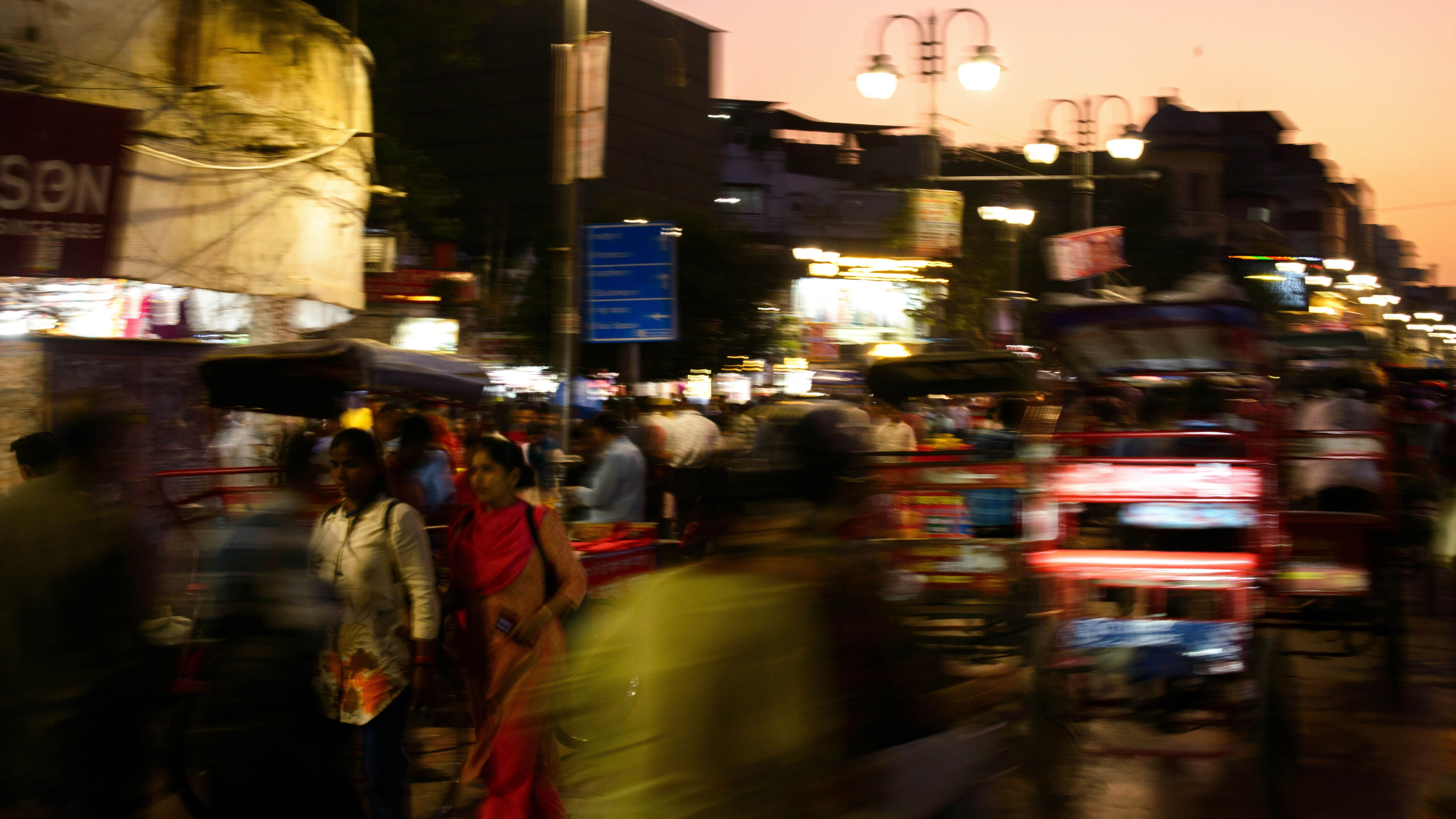
You don't need a thesis to see this. Just look at what's happening on the ground in Delhi right now.
India now hosts over 1,500 running events each year, generating close to Rs 3,700 crore in revenue. The country is home to an estimated 2.5 million registered runners. Clubs like Bhag Club in Delhi have turned weekend runs into social phenomena, blending fitness, fun, and community with hundreds of participants and massive social media traction. According to Strava's Year in Sport Trend Report, India recorded a 59% increase in running club activity in a single year. Running was always individual. Suddenly it's the most social thing young Delhi does on a Sunday morning.
Pickleball is an even starker example. Delhi rooftops, schoolyards, and farmhouses are being converted into pickleball courts. There are at least 20 pickleball court projects in the pipeline across Delhi-NCR alone. Residential societies that originally planned for tennis and badminton are switching to pickleball because demand is outrunning supply. A sport barely anyone in India knew five years ago now has waitlists.
Then there's what might be the most interesting signal of all: stranger dinners. Timeleft runs a weekly "Dinner with 5 Strangers" concept in Delhi NCR, matching people based on personality quizzes and seating them together at restaurants with no prior acquaintance. Step Out curates intimate dinners with 6 strangers. Seré Supper Club hosts Sunday morning breakfast gatherings for people who've never met. The willingness to spend money to have dinner with strangers highlights the extent of something deeper — a growing desperation to break free from the confines of the online world.
People are paying money to have dinner with people they don't know. Think about that for a moment. That's how hungry the city is for real connection.
Delhi NCR now has 40+ hobby clubs through Misfits alone. Book clubs in Lodhi Garden. Art collectives. Social walking tours. Classical music listening rooms. The city's social infrastructure is being rebuilt from scratch, entirely outside of digital platforms, entirely by people who decided that the screen wasn't enough.
This is not nostalgia. This is a generation that grew up online deciding, collectively, that online is not sufficient for the life they want to live.
Covid is over. People remember what they missed.
There is a specific quality to the going-out culture of the last two years that is different from anything before the pandemic. People who spent eighteen months unable to leave their homes came out the other side with a visceral understanding of what physical presence costs when it's taken away.
The restaurants in Delhi are not just full because the economy is good. They are full because people remember sitting at home alone, unable to go anywhere, and they have made a quiet decision that they are not doing that again by choice.
The run clubs, the pickleball courts, the stranger dinners — none of these blew up because of marketing. They blew up because they offered something that a locked-down generation had been starved of: the experience of being in a room with other people who showed up for the same reason.
Post-Covid going-out is not the same as pre-Covid going-out. It's more intentional. More valued. More worth rewarding.
AI is about to give people back their time
JPMorgan, Goldman Sachs, Ford, Salesforce. Executives across every major industry are saying AI is taking over jobs. Ford's CEO warned it will replace half of all white-collar workers. Salesforce's Marc Benioff claimed AI is already doing up to 50% of his company's workload.
A World Bank report highlighted that unlike previous waves of automation, AI has the potential to displace a range of non-routine, white-collar service sector jobs — exactly the jobs that India built its economy on.
I'm not writing this to be alarmist about employment. I'm making a different point entirely.
When a generation of knowledge workers finds that AI has compressed the number of hours of focused work required to produce the same output, what do they do with the remaining time? They don't sit at their desks. They go out. They join the run club. They book the stranger dinner. They show up to the pickleball court at 7am on a Saturday.
Every major productivity revolution in history — the industrial revolution, the washing machine, the internet — created leisure time as a byproduct. That leisure time went somewhere. It went to restaurants, theatres, sports, and every form of physical experience the culture had on offer. AI is the next productivity revolution. The leisure dividend is coming.
The generation with the most spending power in Indian history prefers experiences
India's Gen Z has a collective spending power of $860 billion today, projected to reach $2 trillion by 2035. By 2029, over half of India's population will be Gen Alpha and Gen Z.
Despite 95% smartphone penetration, the majority of Indian Gen Z still prefers in-store and physical experiences, blending online discovery with offline presence.
78% of millennials would rather spend money on a desirable experience than on a material thing, and 72% say they want to increase their spending on experiences rather than physical things in the coming year.
This is not a niche preference. It is the defining consumption behaviour of the largest, wealthiest, most influential generation India has ever produced. And every platform they currently use — Zomato, Instagram, Google — is built for the wrong thing.
Zomato is a delivery company. Instagram is a content platform. Google Maps tells you where something is, not whether it's worth your Friday night. None of them are built around the actual act of going out.
What Hubb is
Hubb is the infrastructure for the going-out city. We make it easier to discover the right places, and we reward people for actually showing up.
The mechanics are simple. Discover curated premium offline brands across dining, retail, and experiences in Delhi NCR. Earn Hubb points when you transact. Redeem those points across the entire Hubb network — not locked to a single store, but usable everywhere Hubb exists. One wallet. The whole city.
We launched with 80+ partner brands across 200+ locations in Delhi NCR. Weekly transaction growth is strong. The early data confirms the core insight: when you give people a curated reason to discover a place and a real reward for showing up, they show up. And they come back.
Delhi is where we're proving this. A city that has bars ranking top 10 in Asia, restaurants on Asia's 50 Best list for 13 consecutive years, a pickleball boom with 20 courts in the pipeline, run clubs turning parks into weekly social events, and stranger dinners filling up weeks in advance. All of this happening simultaneously. All of it pointing in the same direction.
The going-out economy is not a trend. It's a structural shift. And the company that builds the discovery and rewards layer for offline India in this window will become the infrastructure that premium brands and city-dwellers cannot operate without.
We are building that company. In the right city. At exactly the right time.
Discover Delhi on Hubb
The city is calling. We built the way in.
More in Founders